
OnlyFans gives subscribers no built-in way to compare creators before paying, so external ranking cards often carry the first useful data a buyer sees. This article explains how to read those cards properly, which signals matter, and how BestOnlyFans and similar projects build the activity scores behind a position number.
A ranking card is a compressed snapshot of observable data: price points, posting estimates, follower movement, and the date those figures were last confirmed.

What Ranking Cards Reveal That OnlyFans Hides
There is no searchable catalogue of pages, no trending section, and no way to sort creators by price or update history. You find a page through an external link, a social post, or a ranking site.

Because the platform hides comparative data, external rankings fill the gap by surfacing things a profile page never shows. A creator’s own page displays a subscription price and a media count, but it does not show how that price has changed over twelve months.
Subscriber-focused ranking cards usually surface five categories of information:
- Historical price points, including previous base rates and any promotional months that ran below the $4.99 minimum.
- Posting frequency estimates, usually expressed as posts per week or month rather than exact dates.
- Follower growth trajectories, tracked as snapshots over time rather than a single live number.
- Content type tagging, which groups pages by the kind of media they publish most often.
- Temporal activity stamps, showing the last date any of the above was verified.
A price history with no timestamp is close to useless, and a follower count without a comparison point tells you nothing about direction. The value comes from reading them together.
Timestamp Decay: Recognizing Stale Activity Data
Every ranking card ages. The moment a snapshot is published, the data behind it starts drifting away from reality. A page listed at $9.99 may have moved to $14.99 three weeks later.
Timestamp decay is the rate at which a card’s usefulness falls as its verification date recedes.
Five freshness indicators tell you how much to trust a card:
- Last update metadata, usually a visible date near the card header or footer.
- Data source versioning, which shows whether the site revised its collection method.
- Creator confirmation dates, where a page owner has verified their own listing.
- User report timestamps, showing when subscribers last submitted corrections.
- Platform API sync indicators, which flag whether the site pulls live figures or relies on manual entry.
A card with a recent update date but no source information is weaker than an older card that documents exactly where each figure came from.
Warning: if a ranking card shows a price below $4.99 as the base subscription, that figure is either a promotional first month or an error. OnlyFans does not allow a standard base price under $4.99, so treat any lower number as a temporary offer and check the renewal rate.
Some creators change prices and posting habits frequently, which means any snapshot has a short shelf life.
Price History Trajectories and Creator Stability
Price movement is one of the clearest signals of how a creator runs their business. It shows whether a page is treated as a long-term project or a short experiment.
Four broad patterns appear across most price histories:
- Stable flat pricing, where the base rate sits at one figure for six months or longer.
- Gradual step increases, small rises every few months as an audience grows.
- Promotional cycling, repeated first-month discounts followed by a return to the base rate.
- Erratic fluctuation, sharp rises and falls with no clear interval.
Promotional cycling is normal and often good value if you understand that the discount applies only to the first month. Erratic fluctuation is the pattern that deserves the most caution, because it usually means the creator is testing what the market will bear.
One platform rule matters here. When a creator raises the price, auto-renew stops for existing subscribers, and access continues only until the already-paid period ends.

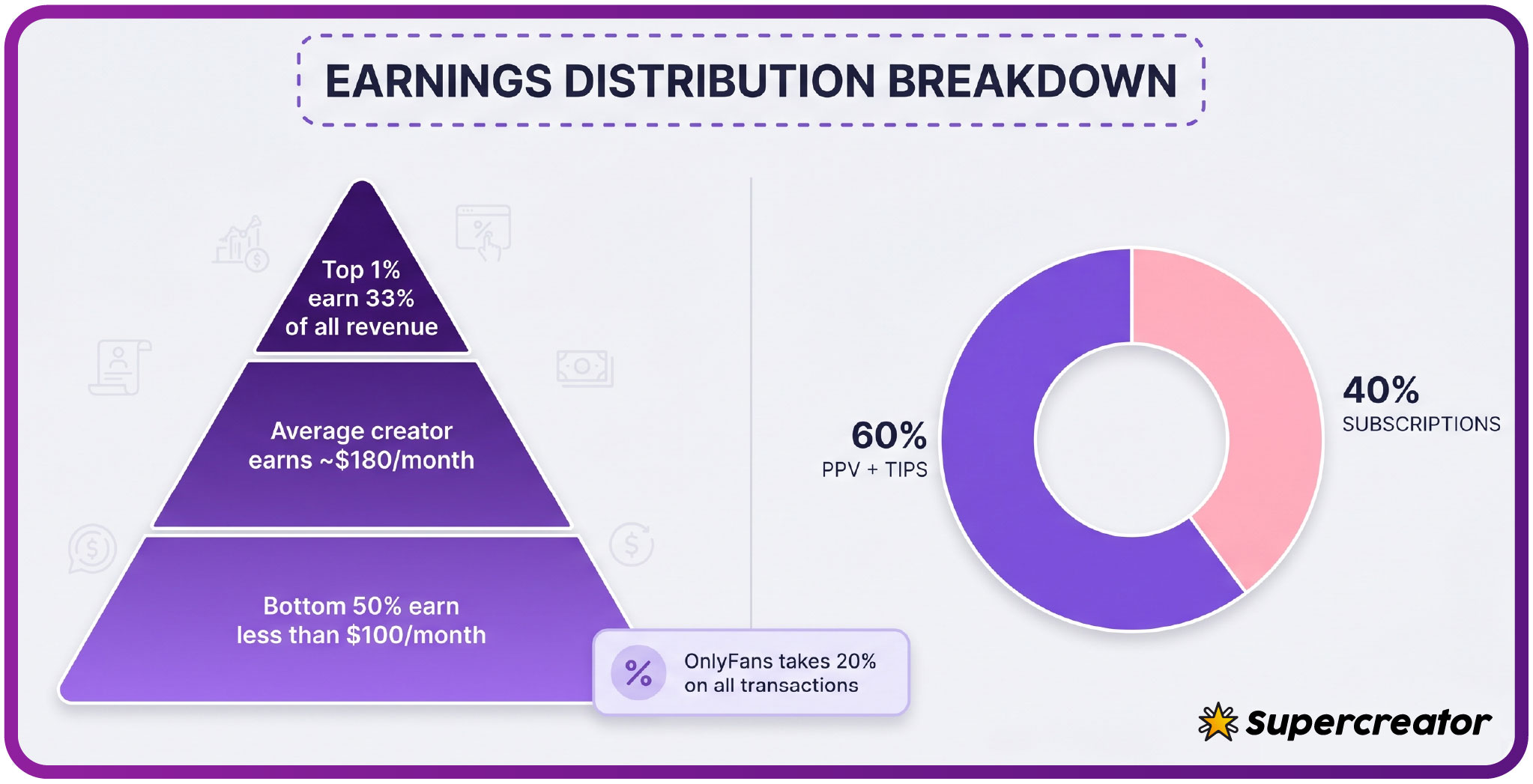
OnlyFans takes a 20% fee on everything, so the creator keeps 80% of the subscription, the tips, and each pay-per-view unlock. Paid chat commonly runs $3 to $5 per message, PPV messages unlock for up to $50, and tips can reach $100.
Typical paid pages sit in the $4.99 to $15 range, with most clustering around $5 to $10, while free pages earn through PPV messages and tips instead of a base rate.
Posting Frequency Patterns and Content Reliability
Posting frequency is the metric subscribers feel most directly, because it determines whether a page stays interesting after the first week.
A card that reports daily activity based on a two-week sample may not reflect the following month, especially for creators who work in bursts.
| Activity Metric | Reliable Signal Threshold | Interpretation |
|---|---|---|
| Posts per week | 3 or more, sustained over 8 weeks | Consistent production, low risk of a quiet page |
| Posts per month | 8 to 12, with even spacing | Steady output, likely a part-time schedule |
| Gap between posts | Under 7 days on average | Active page, worth the subscription rate |
| Burst pattern | Clusters followed by 10+ day gaps | Irregular output, value depends on timing |
| Declining trend | Falling counts across 3 snapshots | Possible wind-down, check before renewing |
Read the table alongside price data. A page posting three times a week at $9.99 is a different proposition from a page posting once a week at the same rate, even though both may sit near each other in a ranking.
When output is high and price is stable, the page is doing the work its rate implies. When output drops but the price holds or rises, the card is warning you about a change in direction.
Cross-Referencing Multiple Ranking Sources
Each source samples differently, updates on its own schedule, and weighs inputs according to its own method. Comparing two or three sources side by side catches errors that a single card would hide.
Five comparison points do most of the work:
- Price agreement across sites, where matching figures suggest an accurate listing.
- Follower count variance, where large gaps point to different snapshot dates.
- Activity date alignment, where sources agree on when a creator last posted.
- Content category consistency, where the same tags appear in more than one place.
- Promotional status confirmation, where a discount appears across multiple cards.
When sources disagree, the older or less documented figure is usually the wrong one. Where two sites agree but a third differs sharply, the outlier often reflects a data collection error rather than a real change.

Cross-referencing also protects against the small number of listings that are simply fake. Creators who market through short-form video platforms, including those listed as the best onlyfans tiktok accounts, tend to appear across several ranking sources at once, which makes agreement easier to check.
Red Flags in Ranking Data That Suggest Caution
None of them is proof of anything on its own, but two or more together justify slowing down before you enter card details.
- Prices that do not match the claimed tier, such as a listing described as premium with a $4.99 base rate.
- Activity stamps older than 30 days with no update history behind them.
- Dramatic follower drops between consecutive snapshots, which can indicate a purge or an abandoned page.
- Category tags that conflict with the content description, which suggests the listing was copied or auto-generated.
Payment-related warnings deserve the same attention. A creator or a third-party site that asks for payment outside the platform, or that requests card details through a message, is following a pattern documented in guides on phishing scams.
Legitimate subscriptions are paid on the platform with a card on file, and the standard $0.10 verification hold is refunded within days. Enabling two-factor authentication on your account limits the damage if a password is reused elsewhere, and it takes under a minute to switch on.

A page with an unclear price, an old activity stamp, and a follower count that jumped unnaturally is not worth the card verification step. Move on and check the next listing.
BestOnlyFans Methodology: How Activity Scores Are Built
Understanding how a score is constructed tells you what it can and cannot answer. The BestOnlyFans approach combines several inputs, each weighted differently, and each with its own update cycle. No single input dominates, which reduces the chance that one bad figure distorts a position.
| Data Source | Weight in Score | Update Frequency |
|---|---|---|
| Public price history | High | Weekly |
| Posting frequency estimate | High | Weekly |
| Follower snapshots | Medium | Every two weeks |
| Category tagging | Medium | Monthly |
| User-submitted corrections | Low | Continuous |
It also reflects the sampling window, so a creator who changes pace this week may still carry last month’s rating. A high position tells you a page has shown consistent, verifiable activity across the tracked period, not that the content will suit your taste.
The platform itself has changed shape considerably since 2016, and subscriber numbers expanded sharply around 2020, which is why older comparison guides no longer describe the current market.

FAQ
How often do ranking sites update their OnlyFans data?
Update cycles vary widely. Some sites refresh price and posting estimates weekly, while others run monthly snapshots or rely on manual submissions. Check the visible update date before trusting any figure, and treat anything older than a month as a prompt to verify directly.
Can ranking card timestamps tell me when a creator last posted?
Not precisely. An activity stamp shows when the site last checked the page, not when the creator last published. A recent stamp means the data was refreshed, while a gap between posting estimates and the stamp date tells you how current the underlying sample is.
Why do two ranking sites show different prices for the same creator?
Different snapshot dates are the usual cause. If one site captured the page during a promotional first month at $3 and another captured it after the rate returned to $9.99, both figures are technically accurate. Compare update dates before assuming an error.
Should I trust a ranking if the creator’s follower count seems inflated?
Treat a sudden jump with caution. Large increases between short intervals can reflect promotion, a viral clip, or purchased followers. Cross-check the same creator on a second source, and look at whether posting activity and price history moved in a way that supports the growth.

Reading ranking cards well comes down to three habits: check the date, compare at least two sources, and match price against posting frequency. Those steps take a few minutes and usually prevent the most common subscription disappointments.